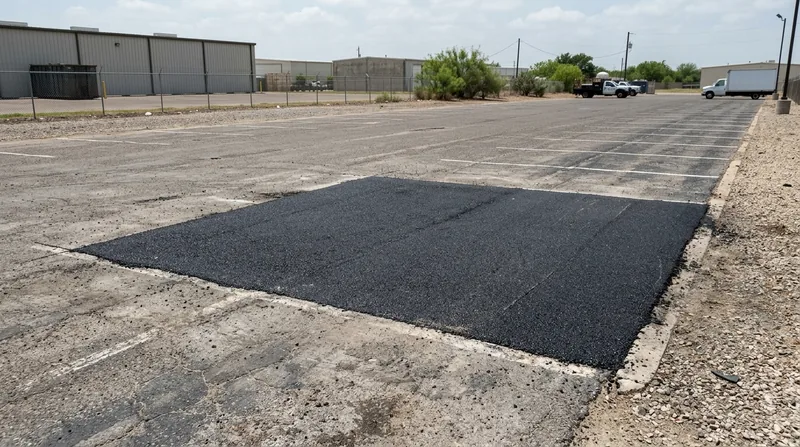




Parking Lot Repair & Resurfacing in Brownsville solves a problem unique to the Rio Grande Valley: delta clay underneath your asphalt swells when it gets wet and shrinks hard when it dries, cracking the pavement in a cycle that repeats every storm season. Brownsville's flat terrain and heavy clay base mean water sits on the surface after a Gulf downpour instead of draining away, working the cracks deeper. We cut out the failed section, rebuild the base so it bridges the clay movement, and patch it flush so it holds through the next hurricane. The result is a lot that sheds water properly and stays intact through the subtropical heat and storm season that breaks most asphalt after a few years. We've been doing this work across Cameron County since 2013, and we know exactly what fails here and why.
Why Parking Lot Repair Matters in Brownsville: Clay Movement and Water Pooling
Commercial lots across Brownsville, Harlingen, and San Benito sit on the same delta clay that built the Valley. When asphalt cracks, water seeps into the base, softens it, and the clay underneath starts to work. In summer heat the clay shrinks, opening the crack wider. When the rain comes, it swells again, pushing the edges up and creating a lip that catches tires and collects standing water. A small crack becomes a pothole, a pothole becomes a section failure, and a section failure can force you to close a parking area or risk liability. Catching the damage early with targeted repair keeps you from paying for a full resurfacing or replacement down the line.
- We identify which cracks are surface only and which ones signal base failure underneath.
- We cut out failed sections in a clean rectangle so the new patch bonds properly and doesn't unravel at the edges.
- We rebuild the base with compacted aggregate so it supports the asphalt and doesn't move with the clay.
- We match the new asphalt to the existing surface and slope it so water runs off instead of pooling.
- We use the same hot mix that was laid originally, so the patch integrates and cures properly in Brownsville's heat.
Repairing sections early stops small problems from becoming expensive ones, and it extends the life of your lot by five to ten years.
Key info: A strip mall in Brownsville near the resaca developed a line of cracks running parallel to the building, caused by clay swelling and water pooling at the low point. We cut out the failed strip, raised the grade slightly, and added a French drain to shed the runoff. The lot has held solid for eight years since. That's the difference between repair targeted at the root cause and patching that ignores it.
For more detail on how parking lot damage develops and what repair options exist, see our guide to pothole repair and asphalt patching, which covers the same base-failure mechanics.
How We Repair and Resurface Parking Lots in Brownsville: Step by Step
A parking lot repair job starts with a site visit to measure the failed area, probe the base condition, and understand how water is moving across the lot. We check for soft spots, measure the thickness of the existing asphalt, and determine whether the failure is localized (a patch job) or widespread enough that resurfacing makes more sense. We then provide a written estimate with tonnage specifications so you know exactly what you're paying for and what the finished work will look like.
- We mark out the failed section in a clean rectangle, cutting back to solid asphalt at all edges.
- We remove the broken asphalt and probe the base to confirm it's stable or identify soft spots that need rework.
- We add compacted aggregate base if the existing base is thin or damaged, bringing it to the thickness needed for your lot's traffic load.
- We proof roll the base (drive a heavy roller over it) to confirm it's solid and won't move under load.
- We heat the edges of the existing asphalt so the new patch bonds chemically instead of sitting on top.
- We lay new hot mix asphalt, compact it to the proper density, and finish it level and smooth.
- We slope the patch to match the lot's drainage pattern so water runs off and doesn't collect at the repair.
The whole job typically takes one to two days depending on the size of the area and the base condition. The new asphalt cures as it cools and is ready for traffic within 24 hours, though we recommend light traffic only for the first week while the material fully sets.
Example: A restaurant parking lot in San Benito had a failed corner section where the delivery truck always turned. The base underneath had broken up from repeated heavy traffic combined with water intrusion. We cut out the damaged asphalt and base, brought in new aggregate, compacted it with a plate compactor, and laid four inches of new hot mix. We sloped the corner slightly toward the storm drain so water wouldn't collect there again. The repair has held for six years through heavy daily use and multiple hurricane seasons.
If your lot has damage across more than thirty to forty percent of the surface, or if you see extensive alligator cracking (a pattern that looks like dried mud), patching throws money away and an asphalt resurfacing or overlay is the smarter investment. We'll tell you honestly which option makes sense for your lot.
Parking Lot Repair Methods: Patch, Overlay, and Full Replacement
| Approach | Description | Best for |
|---|---|---|
| Full-Depth Patch | Cut out failed asphalt and base, rebuild the base with compacted aggregate, lay new hot mix asphalt flush with the existing surface. | Localized failures (potholes, cracked sections) where the surrounding lot is still sound. Most cost-effective for small to medium damage. |
| Asphalt Overlay | Mill off the top layer of damaged asphalt or lay new hot mix directly over the existing surface after cleaning and priming. | Widespread surface cracking and moderate wear across the lot, when the base is still stable. Adds 1.5 to 2 inches of new wearing surface. |
| Full Removal and Replacement | Mill out all existing asphalt, inspect and repair the base, and lay a new asphalt section from the ground up. | Base failure, extensive alligator cracking, or lots where the existing section is too thin to support current traffic. Most expensive but longest-lasting solution. |
| Partial Section Repair with Drainage Upgrade | Cut out failed asphalt, rebuild the base, add a French drain or grade adjustment to redirect surface water away from the repaired area. | Lots where standing water is the root cause of failure. Prevents the same failure from happening again in the same spot. |
Parking Lot Repair & Resurfacing Cost in Brownsville: What to Expect
Parking lot repair pricing starts at around $650 for a small pothole or localized failure, and moves up based on the size of the damaged area, the depth of base work needed, and whether you're adding drainage improvements. A typical section repair covering 200 to 300 square feet runs between $1,200 and $2,500, depending on how much base has to be rebuilt and whether the lot slopes toward the repair (which makes it more complex). If your lot needs an overlay across the entire surface, plan on a higher total cost, but the per-square-foot rate is lower because the volume is larger and we're not doing as much base work.
The biggest cost drivers are the extent of base failure (soft spots cost more to fix because we have to dig deeper and bring in more aggregate), the accessibility of the damaged area (a corner surrounded by parked cars takes longer than an open section), and whether drainage or grading changes are needed to prevent the same failure from happening again. A lot that's holding water in one spot will fail again in that spot unless you fix the drainage, and that adds to the cost upfront but saves you from repeating the repair in two years.
We provide a written estimate with the square footage of the repair, the depth of the base work, and the tonnage of asphalt we'll use, so you can compare our price to other quotes and know what you're paying for. Get two or three estimates before you decide, and ask each contractor to specify tonnage and base depth. A contractor who won't give you tonnage is guessing, and you'll pay for that guessing when the repair fails early.
For a detailed pricing breakdown and examples of typical lot repairs in the Brownsville area, visit our full pricing page.
Parking Lot Repair & Resurfacing Near Me: What Brownsville Property Managers Should Know When Hiring
When you're looking for a contractor to repair your parking lot, the most important thing is to verify that they're actually local and that they understand the specific failure modes of Brownsville's clay and climate. The biggest red flag in the asphalt trade is the itinerant crew that shows up unsolicited claiming they have leftover material from a nearby job and can give you a deal if you sign today. Those crews are out of state, they have no local accountability, and they typically vanish when the repair fails six months later. A local contractor with a local address, local phone number, and a track record in the community is the only safe choice.
Ask for a written estimate that includes the square footage of the repair, the depth of the base work, the tonnage of asphalt, and the timeline. Ask for references from other commercial properties in Brownsville or Harlingen that the contractor has worked on, and call them to confirm the work was done on time and held up. If you have an HOA or a property management company overseeing the lot, check whether there are any architectural or material standards you need to follow before you book the work. Some HOAs have rules about asphalt thickness or color, and we'll follow those standards when we do the repair.
Permitting for parking lot repair varies by municipality. Brownsville, Harlingen, San Benito, and other cities in Cameron County have different rules about when a permit is required and what the process looks like. We help you navigate local permitting and will coordinate with the building department to make sure the work meets code. Before any excavation work (which includes base repair and full-depth patching), Texas law requires a utility locate through the 811 system to mark underground lines so we don't hit a water main or electrical line. We handle that step as part of the job.
For questions about your specific lot or to schedule a free estimate, call us at (956) 338-5955 or visit our contact page. We respond within 24 hours and can usually schedule a site visit within two to three days.
Parking Lot Repair & Resurfacing in Brownsville: Pricing Guide
| Service | Price | Details |
|---|---|---|
| Small pothole or localized patch | Starting at $650 | Single pothole or small cracked section, minimal base work, typical lot accessibility |
| Medium section repair (200-300 sq ft) | Starting at $1,200 | Failed section with base work, includes compacted aggregate base, hot mix asphalt, and slope correction |
| Large section repair or multiple patches | Starting at $2,500 | Extensive damage, significant base rebuild, or drainage improvements to prevent future failure at the same spot |
| Lot-wide overlay or resurfacing | On estimate | Covers the entire lot, requires site measurement and base inspection to determine thickness and tonnage needed |
| Travel and site visit | Included | No mileage fee or travel charge within Brownsville and surrounding Cameron County service areas |
| Free written estimate | No cost | Response within 24 hours, includes square footage, tonnage, and timeline, no obligation to book |
Indicative pricing, the exact cost depends on square footage, finish, and site access. Free personalized estimate within 24h at (956) 338-5955.


